
 EN
EN
 ar
ar bg
bg hr
hr cs
cs da
da nl
nl fi
fi fr
fr de
de el
el hi
hi it
it ko
ko no
no pl
pl pt
pt ro
ro ru
ru es
es sv
sv tl
tl iw
iw id
id lv
lv lt
lt sr
sr sk
sk sl
sl uk
uk vi
vi et
et hu
hu th
th tr
tr fa
fa ms
ms hy
hy ka
ka ur
ur bn
bn mn
mn ta
ta kk
kk uz
uz ku
ku
NB-IoT DTU
The NB-IoT DTU lists Changsha, China, as the place of origin, Kingmach as the brand, GB50982-2014 as the certification, and a minimum order quantity of one piece. Pricing is negotiable, payment terms are T/T in advance, and delivery time is listed as instant. These business details are useful when the platform is purchased together with sensors, data loggers, acquisition modules, communication devices, or a wider monitoring package. They also show that the software is treated as a formal product category within the Kingmach monitoring range.
Application of NB-IoT DTU
Slope monitoring benefits from Kingmach NB-IoT DTU because slope risk often depends on several data types at once. Displacement, rainfall, groundwater, pore pressure, tilt, settlement, and inspection observations all need to be read together. A cloud-based platform can receive wired or wireless device data from field points that are difficult to access. Trend analysis and visual display help users see whether movement follows rainfall, construction disturbance, seasonal water changes, or a developing instability pattern.
The future of NB-IoT DTU
IoT development will make Kingmach NB-IoT DTU more important because field devices will keep expanding in number and variety. A bridge, tunnel, dam, or slope may use wired channels, wireless nodes, edge loggers, weather stations, and third-party devices at the same time. The platform's compatibility with different manufacturers, types, and models supports this mixed-device future. As monitoring networks grow denser, device access, channel naming, alarm rules, and project organization will matter as much as the individual sensor.
Care & Maintenance of NB-IoT DTU
Data quality checks should be routine in Kingmach NB-IoT DTU. Look for missing values, frozen channels, impossible jumps, timestamp errors, unit mismatch, repeated noise, or disagreement between related sensors. A platform can display data quickly, but engineering trust depends on the quality of the incoming records. When a problem appears, check the field device, cable, communication path, acquisition module, and recent configuration changes before treating the reading as structural behavior.
Kingmach NB-IoT DTU
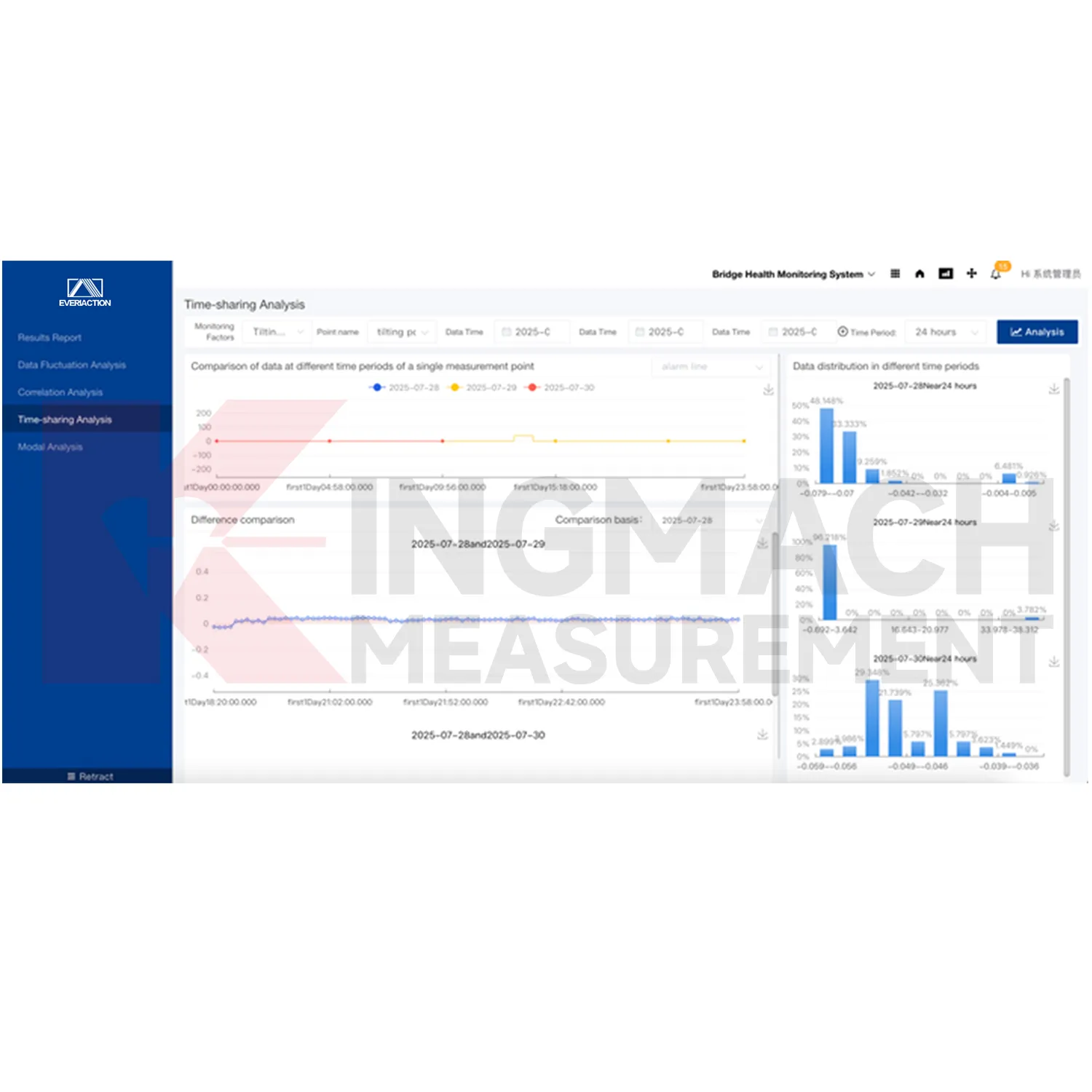
Kingmach NB-IoT DTU supports remote monitoring by letting data move from devices to the Cloud Platform through wired or wireless transmission. This is important for assets that are hard to access, such as slopes, dams, tunnels, bridges, wind towers, and distributed infrastructure. Remote data does not remove the need for site inspection, but it helps teams decide when inspection is needed and where to focus. Real-time storage and filtering also help preserve event records when weather, construction, traffic, or equipment operation changes the monitoring pattern.
FAQ
Q: What certification is listed?
A: The product information lists GB50982-2014 certification.
Q: What is the minimum order quantity?
A: The local product page lists one piece as the minimum order quantity.
Q: What is the delivery time?
A: Delivery time is listed as instant for the software platform.
Q: How is pricing handled?
A: Pricing is listed as negotiable, so project scope, configuration, and integration needs should be confirmed with Kingmach.
Q: What payment term is shown?
A: The local product page lists T/T in advance.
Reviews
Andrew Lee
The visualization software is intuitive and powerful. It helps us analyze monitoring data efficiently.
David Wilson
We purchased displacement transducers and settlement sensors, and the quality exceeded our expectations. Easy installation and reliable performance.
Latest Inquiries
To protect the privacy of our buyers, only public service email domains like Gmail, Yahoo, and MSN will be displayed. Additionally, only a limited portion of the inquiry content will be shown.
Sophia***@gmail.comUnited Kingdom
Good day, we need environmental monitoring sensors including temperature, humidity, and wind sensors...
Olivia***@gmail.comUnited States
Hello, we are currently sourcing high-precision strain gauges and load cells for a bridge monitoring...